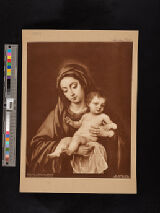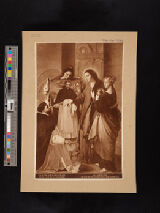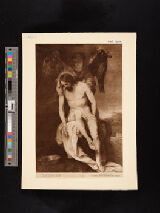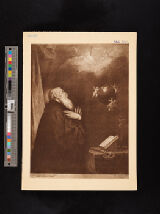
Mora, José de
#1 · 70.00auch: José de Mora WD
Spanish artist (1642-1724) WD (en)
1642–1724 WD
Kurzbiografie
José de Mora (1642–1724) was a Spanish sculptor. José de Mora was born in Baza. He was the oldest son of the sculptor Bernardo de Mora and pupil of Alonso Cano in Granada and of Sebastián de Herrera in Madrid. In 1669, two years after the death of Cano, he moved to Madrid and worked with Sebastián de Herrera Barnuevo who also had been pupil of Cano. In 1672, he became a sculptor for the king Charles II and later left Madrid in 1680 and returned to Granada.[citation needed] He died in Granada in 1724 and was buried in the Convent of St. Anthony of the Discalced Franciscan Friars. His work can be usefully studied in the eight statues in the Chapel of Cardinal Salazar in the Mosque-Cathedral in Córdoba, and in the statues of Saint Bruno and Saint Joseph in the Charterhouse near Granada. However, his main masterpiece was the sculpture of the Christ of Salvation (currently, Christ of Mercy), made for a funerary chapel in the Church of St. Gregory Baeticus in Granada. The origins of this great sculpture were unknown until the year 2018, when Dr. José Antonio Díaz (Art historian from the University of Granada), discovered and published the documents which reveal all the information about this relevant sculpture of the Spanish Baroque. Furthermore, the sculpture of Our Lady of Sorrows made for the Oratory of St. Philip Neri of Granada (currently, in the Church of St. Anne) is known as the second best work carved by José de Mora.
Quelle: Wikipedia (EN), „José de Mora“ (CC BY-SA 4.0) · lokale Kopie, Stand 2026-10-15
Beziehungen
 Alonso Canoim Wörterbuch